




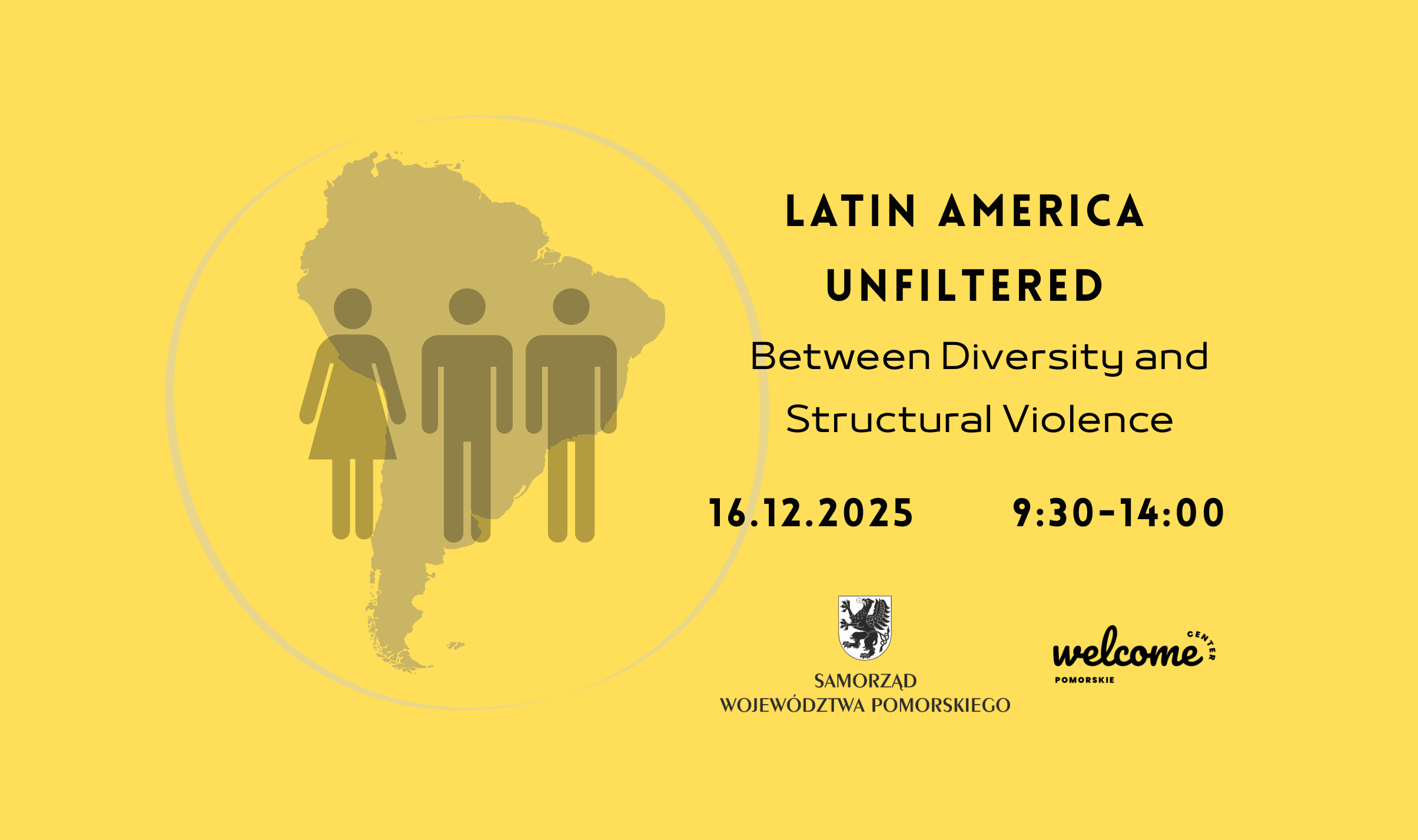
You are invited to the webinar “Latin America Unfiltered: Between Diversity and Structural Violence”. 📅 When: 16 December 2025 (Tuesday), 9:30 AM – 2:00 PM
The webinar will focus on analyzing violence in the region and its multiple dimensions—from government decisions, through mechanisms of exclusion, to interpersonal violence.
Participants will explore the complexity of Latin America, including basic geographic information, major historical processes, and key aspects of politics, economy, and migration, with a special focus on social and cultural structures. The webinar will also examine everyday life from an intersectional perspective, analyzing how overlapping identity categories—race, class, and gender—create different forms of privilege and exclusion. Additionally, factors shaping the sense of security will be discussed, from crime and corruption to social inequalities and government responses, highlighting the multidimensional nature of security, including protection from threats, trust in institutions, social stability, and a sense of justice.
The social and political situation in Latin America has a direct impact on increasing mobility, including decisions to seek safer lives in Europe. In recent years, there has been a notable increase in citizens from Latin American countries arriving in Poland and the Pomeranian region. Understanding the causes of these processes—structural violence, social inequalities, and lack of institutional stability—is crucial for shaping informed local social and integration policies.
During the webinar, we will also explore how these global phenomena affect our region, the challenges and opportunities associated with the growing interest in Pomerania as a place to live, and how to foster understanding for new residents and their migration experiences.
Webinar speakers:
Dr Agata Błoch – historian affiliated with the Institute of History of the Polish Academy of Sciences; teaches a Latin America course at Jagiellonian University. Author of Wolni i zniewoleni (2022) and Marginalizados (published in Portugal, 2025). Her research combines the history of colonialism in Latin America, the Atlantic region, and Portuguese West Africa with the analysis of colonial slavery, social inequalities, access to archives, and the role of public knowledge. Currently conducting research projects on “Colonial Inhabitants of Brazil and West Africa” and projects related to crises and disasters.
Dr Dagmara Szczepańska – sociologist and Latin Americanist at the Department of Sociology of Social Change, Maria Grzegorzewska University of Special Education, Warsaw. She specializes in social and political phenomena, with particular attention to gender equality, collective identities, and mechanisms shaping social attitudes and intergroup relations. Her research combines sociological and psychological perspectives, using both qualitative and quantitative methods.
Dr Magdalena Walczuk – Brazilianist affiliated with the Institute of Iberian and Ibero-American Studies at the University of Warsaw, working as an assistant professor in the Department of Brazilian Studies. Her research focuses on the culture and social history of marginalized groups in Brazil from postcolonial and decolonial perspectives, issues of national and ethno-racial identity of the African diaspora in Latin America and the Caribbean, as well as indigenous literature and culture in Brazil. Co-founder and president of the Brazilian Culture Foundation Terra Brasilis (established in 2011).